
How do marketing agencies describe themselves? Half use the same five phrases
The short answer: Agency Field Guide read the home, about and services pages of 6,453 English-language agencies. Half of them (50.7%) describe themselves with at least one of five stock phrases, and “data-driven” leads at 33.6%. The biggest predictor isn't size, location or niche. It's how many services an agency sells: 69% of agencies listing 10 or more services use one of the phrases, compared with 37% of agencies listing three or fewer.
- 50.7%of agencies use at least one of the five phrases
- 33.6%say some version of “data-driven”
- 0.6%say they're “not your typical agency”
About a third of marketing agencies describe themselves as data-driven. The phrase has no precise meaning. There's no threshold an agency has to cross to earn it, and no test that could show one agency is data-driven and another isn't.
That leaves each agency to define the term for itself, which makes the claim impossible to verify. “Results-focused,” “client-centric” and “an extension of your team” work the same way.
Repeat a word often enough and it stops registering as meaning anything. Psychologists call that semantic satiation, and agency websites are full of it.
Which phrases do agencies use most?
“Data-driven” is the default self-description, used by one agency in three. Results and ROI claims come second, at roughly one in five.
How agencies describe themselves
A third of agencies call themselves data-driven
Data-driven leads at 33.6%. Not your typical agency trails at 0.6%.
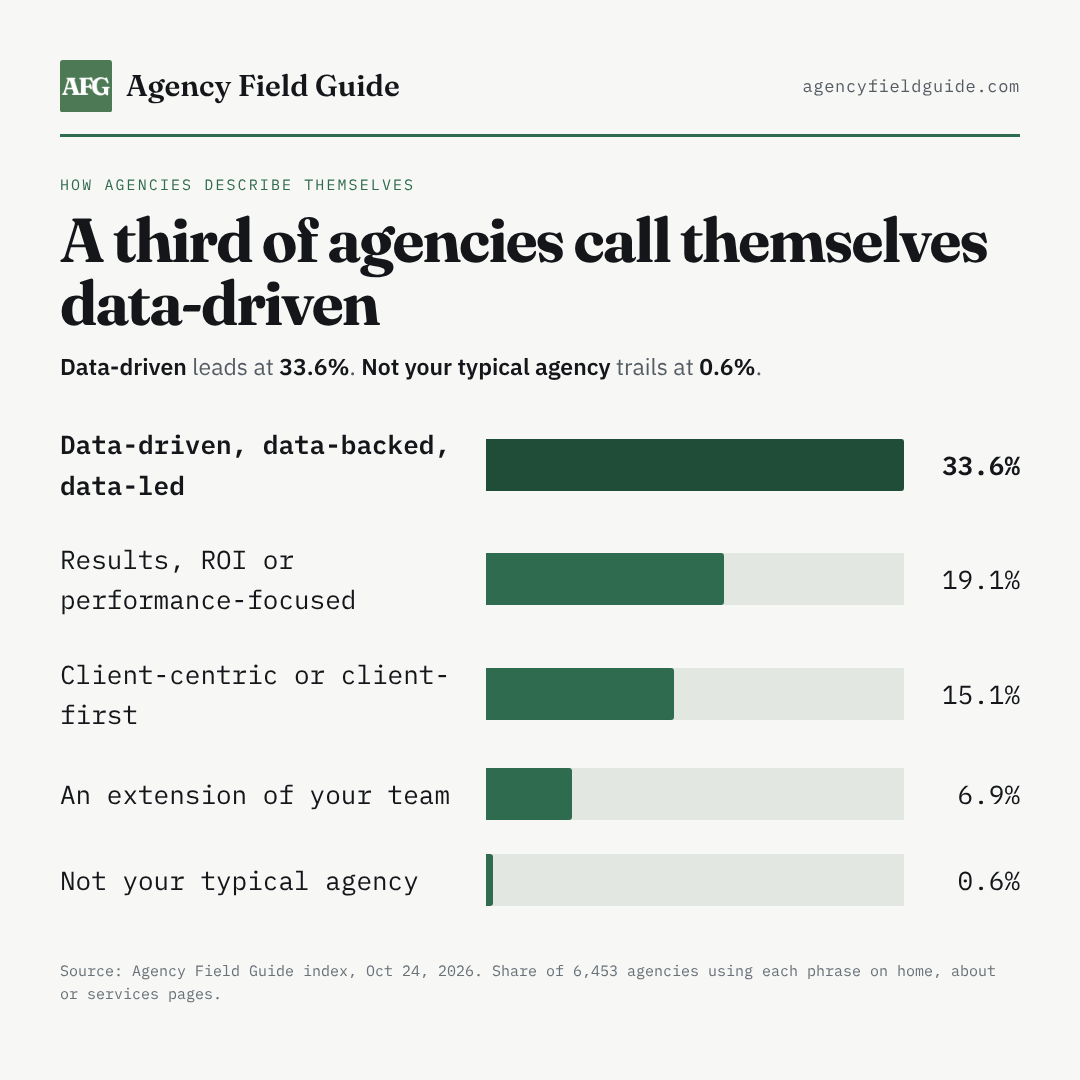
“An extension of your team” is rarer than its reputation suggests, at 6.9%. Only 37 agencies say they're not a typical agency, so the 37 that do are, technically, telling the truth.
How many agencies stack the phrases?
Most agencies that use one stock phrase stop there. About one in five (19.6%) use two or more, and 4.4% use three or more.
Stacking the phrases
Half of agencies use none of the five phrases
49.3% use none. 4.4% use three or more.
- 49.3%None
- 31.1%One
- 15.2%Two
- 4.0%Three
- 0.5%Four
- <0.1%All five
Number of the five phrases on an agency's positioning pages
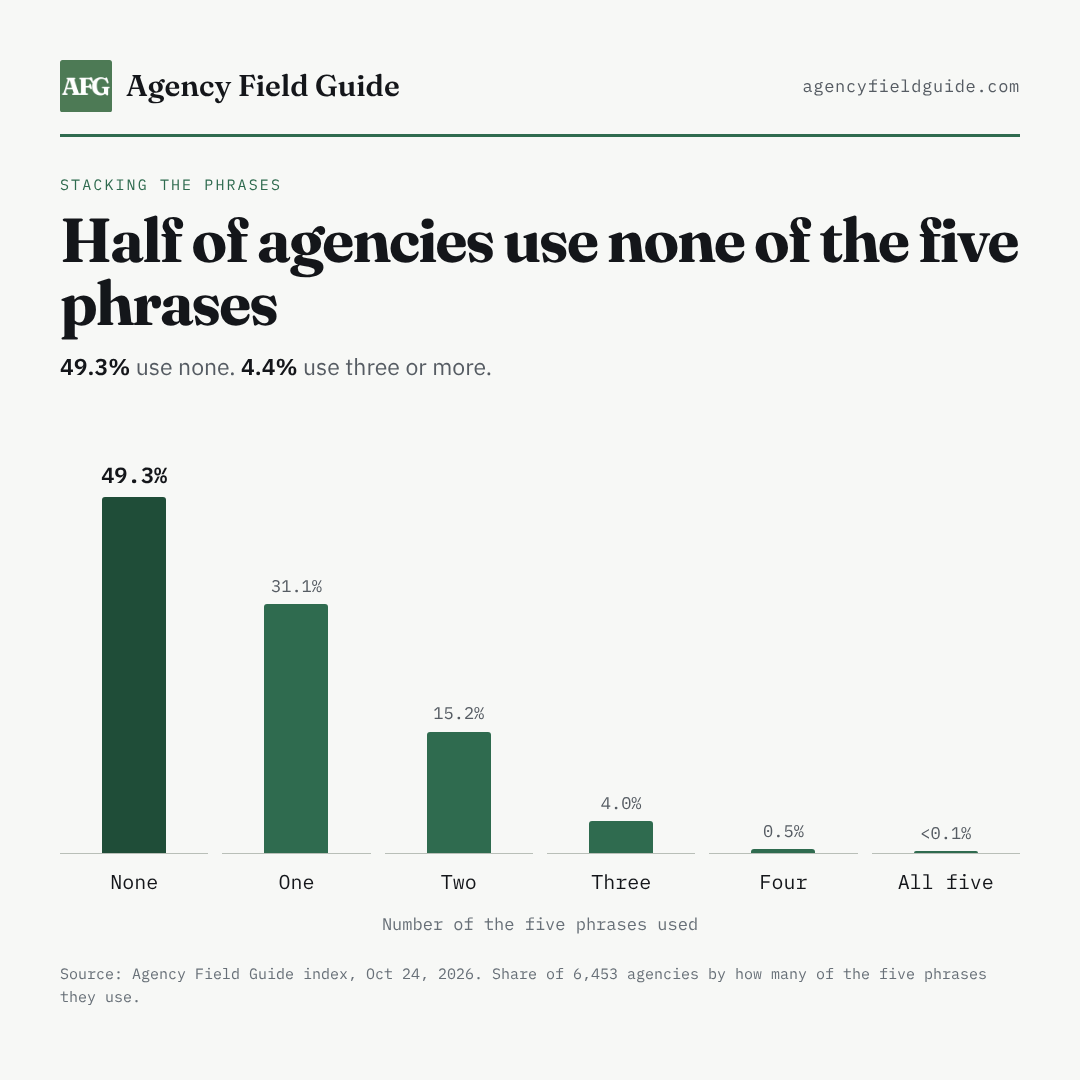
One agency in the index uses all five, including the line about not being a typical agency.
Which agencies are most likely to use the phrases?
Service breadth is the one cut that moves the number a lot. Agencies listing 10 or more services are nearly twice as likely to use a stock phrase as agencies listing three or fewer, and their use of “data-driven” jumps from 18.4% to 53.2%.
Who uses them most
The more services an agency sells, the more likely it uses stock phrases
37.0% of agencies listing three or fewer services use one. 68.6% of agencies listing ten or more do.
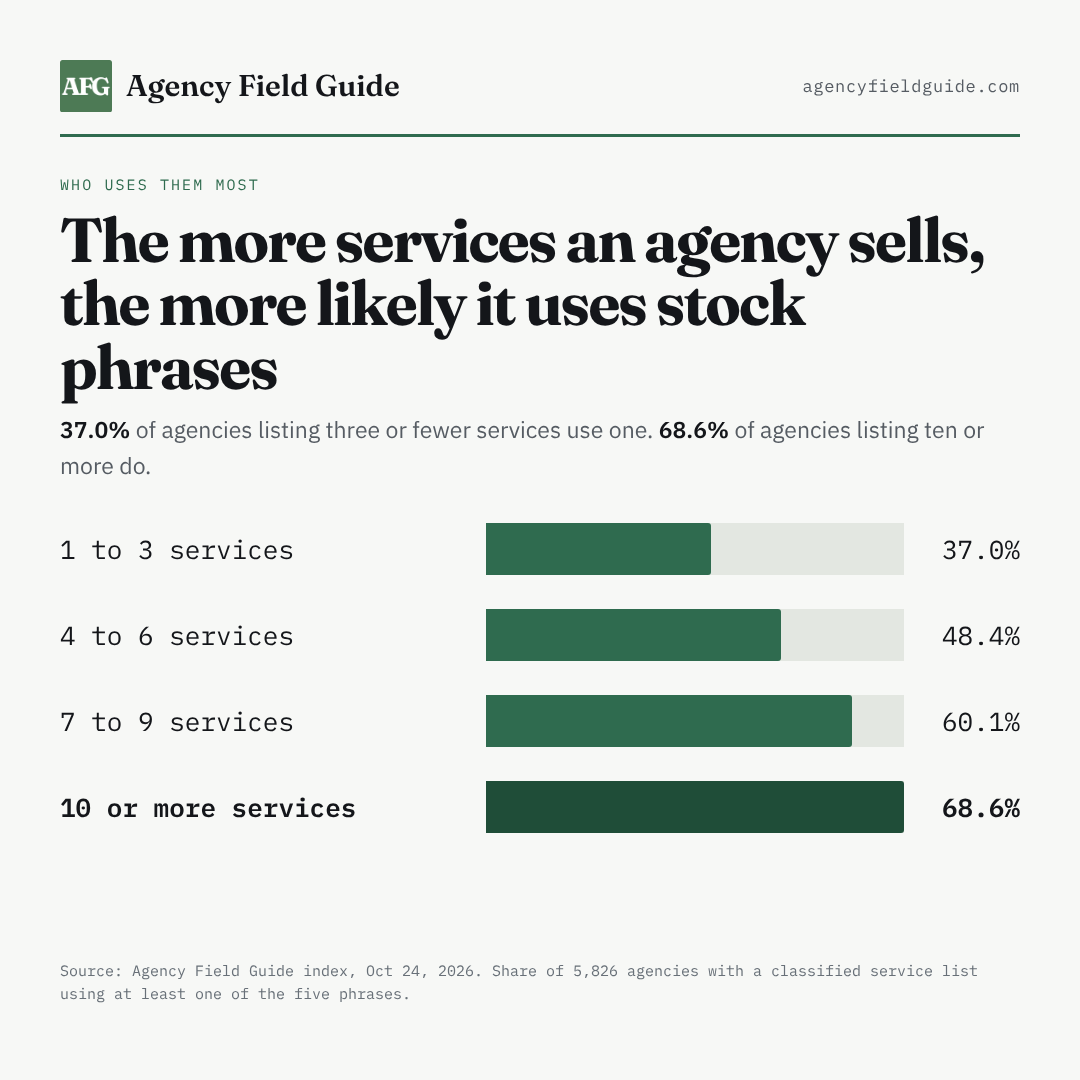
A broad menu is hard to summarize in one sentence, so the summary falls back on adjectives that fit every service at once. A focused agency can describe what it does instead.
Team size matters less. Agencies with 51 to 200 people use the phrases most, and the smallest shops use them least.
By team size
Smaller agencies use the phrases a little less
44.2% of agencies with 10 or fewer people use one, against 57.7% with 51 to 200.
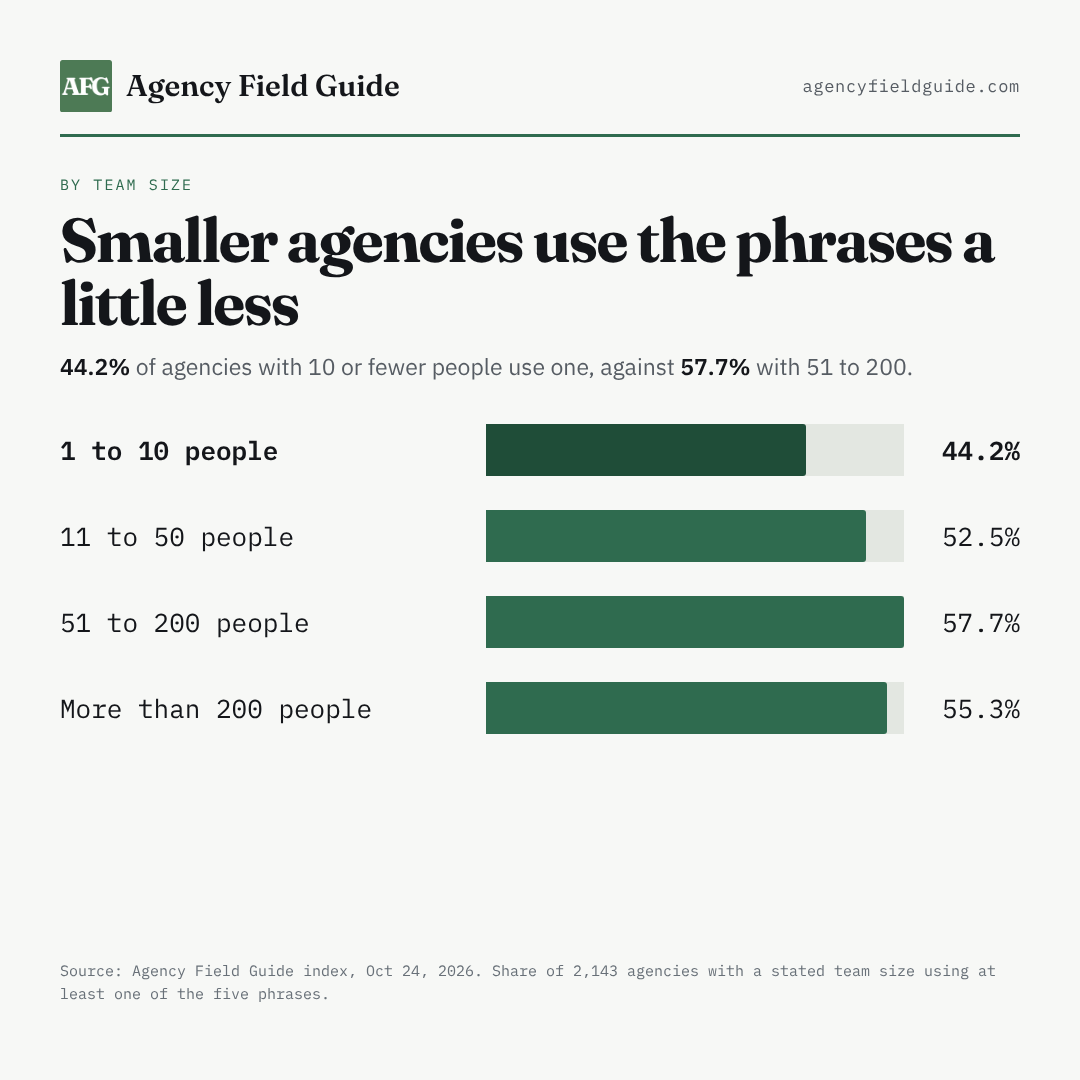
The other cuts barely move the number. Picking an industry niche doesn't change how an agency describes itself: agencies focused on one industry use a stock phrase 52.6% of the time, and agencies serving four or more industries use one 51.0% of the time. Location barely matters either, with 50.8% of U.S. agencies and 50.6% of Canadian agencies using one. Among the largest U.S. states, New York agencies use the phrases least (46.5%) and Texas agencies use them most (53.7%). Agency age moves the number a few points, from 48.3% for agencies founded before 2000 to 54.2% for agencies founded in 2018 or later.
Which other words show up everywhere?
The five phrases aren't the whole story. “Transparent” appears on 36.5% of agencies' positioning pages and “innovative” on 33.6%, which puts both level with or above “data-driven.”
Beyond the big five
“Transparent” and “innovative” are as common as “data-driven”
36.5% say transparent and 33.6% say innovative, level with data-driven at 33.6%.
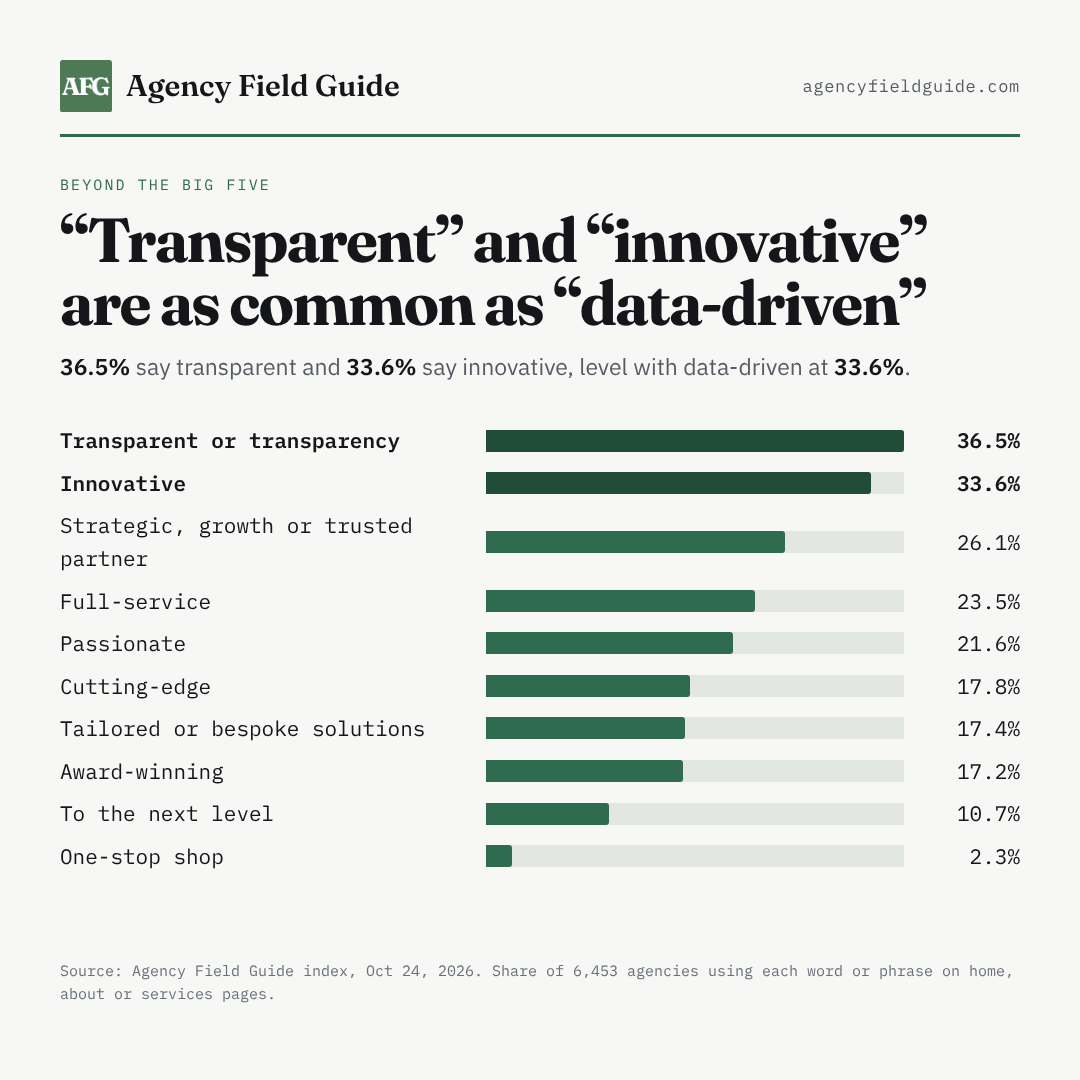
Single words like “transparent” and “innovative” also catch some ordinary uses, such as a page explaining transparent pricing, so read these shares as upper bounds. “One-stop shop” has mostly retired, at 2.3%. “Take your business to the next level” hasn't, at 10.7%.
Does sounding the same actually cost you anything?
Probably, though the best evidence comes from a neighboring problem. LinkedIn's B2B Institute studied what it calls the sea of sameness in B2B marketing, and two of its findings apply here.
- People remember what breaks the pattern. The research leans on the Von Restorff effect, first described in 1933: when one item stands apart from a set of similar items, people are more likely to remember it.
- Lookalikes get credited to the biggest name. In a logo-blind test of five cloud brands, only 5.75% of people matched each brand to its color, and assets were misattributed to Microsoft nearly twice as often as to any other brand. LinkedIn's conclusion is that an ad that looks like a competitor's works as an ad for that competitor.
For an agency, the parallel is a buyer comparing four shortlisted websites that all say the same thing. If the copy doesn't separate them, something else will, and that something is usually price, a referral or the best-known name.
The study comes with real caveats, and they matter here:
- It measured visual brand assets (colors, characters, jingles), not website copy.
- It studied cloud computing brands, not agencies.
- LinkedIn sells advertising and offers a paid program built around this research.
Treat it as a strong signal about memory and attribution, not as proof that a particular phrase costs an agency a particular deal.
What do agencies that skip the phrases say instead?
Skipping the clichés doesn't make an agency distinctive by default. Plenty of the 49% that use none of the five simply say less. The ones that do stand out tend to do one of four things, based on a read of the stated positions in our index:
- They state a working rule someone could disagree with. One Amazon agency says it manages accounts product by product instead of using standard campaign structures. A web studio serving auto detailers says it won't build on WordPress at all.
- They say who they're for and who they're not. One studio works only with mission-driven organizations, and another won't take work linked to fossil fuels.
- They describe how the work actually runs. Examples include fully asynchronous delivery with no standing meetings, no long-term contracts with the client owning its data, and managing media budgets as a fiduciary.
- They name the usual approach and do the opposite. One media agency says most shops plan nationally and optimize locally, and that it builds plans market by market instead.
The agencies using the clichés usually have the proof
The agencies leaning hardest on the stock phrases aren't the ones with nothing to show. Of the agencies using three or more, 70% publish case studies with metrics and 81% put numbers on their positioning pages. Among agencies using none of the phrases, those shares are 49% and 62%.
The proof is already there
Agencies leaning on the phrases usually have the proof
70% of heavy users publish case-study metrics, against 49% of agencies using none.
- Agencies using three or more phrases (288)
- Agencies using none (3,184)
- Numbers on positioning pages
- Case studies with metrics
- Names clients
- Publishes pricing
- Says who it won't serve
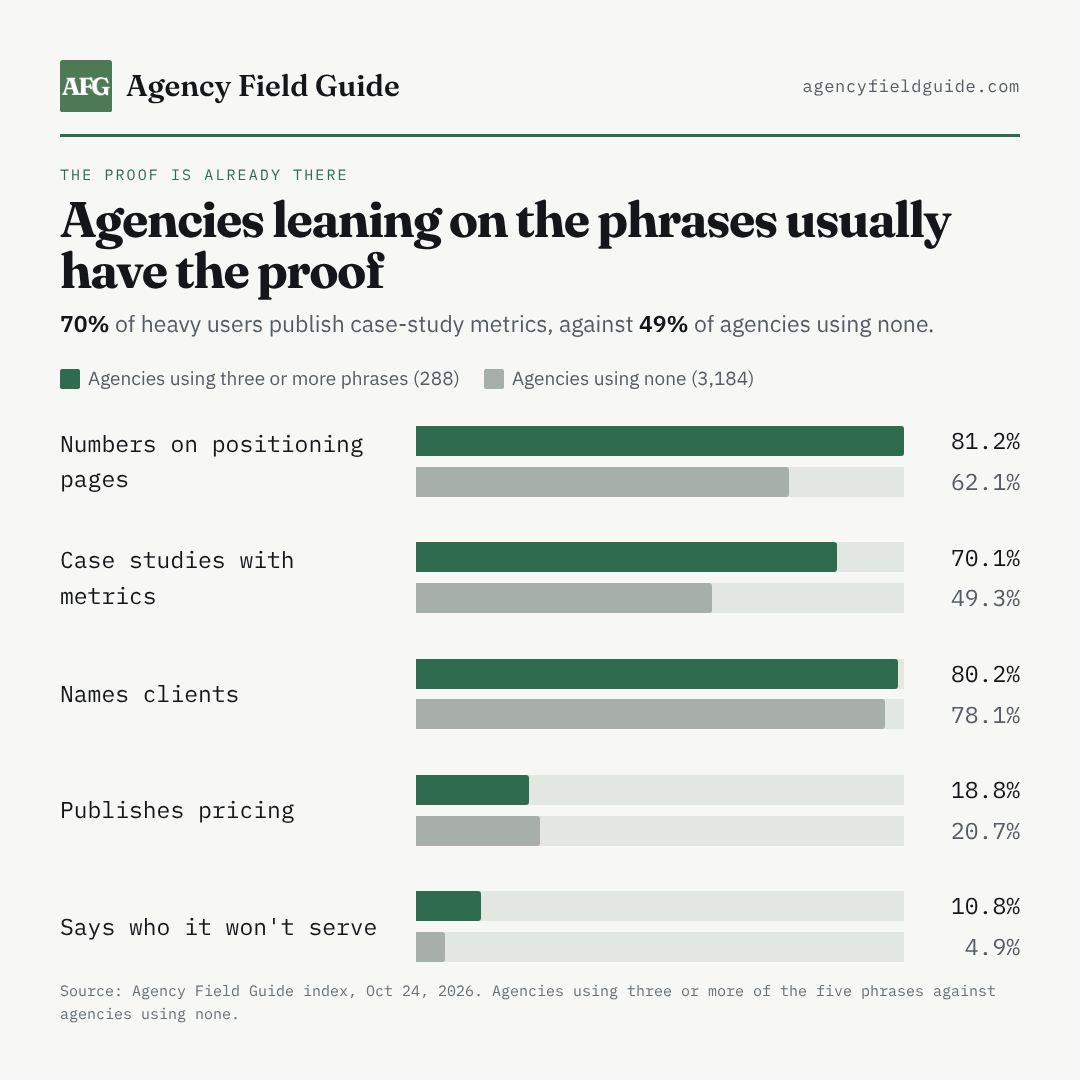
In other words, the cliché often sits right above the evidence that could replace it. Part of this gap comes from breadth: agencies that sell more services tend to have longer pages and more case studies, which gives them more chances to use any phrase and more proof to show.
Should you delete “data-driven” from your website?
It shouldn't go automatically. Each stock phrase on a services page deserves one of two decisions.
- KeepKeep it only if you'll carry the burden that comes with it. A phrase like “data-driven” has no shared definition, so the agency that uses it has to supply three things: its own definition, proof that it actually works that way, and the impact on a client. Most agencies that lean on these phrases already publish metrics, so the proof often exists and just needs to sit next to the claim.
- CutCut it if you can't supply all three on the same page. Without them, the phrase is only there because every other agency has it.
Positioning works when it assembles an agency's attributes, gives them credibility and shows their impact. Saying an agency is client-centric is boring. Saying it's client-centric and telling the stories that show it is interesting. Telling those stories and showing how that approach improved a client's outcome is exciting.
The logo-swap test
These questions work for agencies reviewing their own site and for brands comparing a shortlist.
- If you put a competitor's logo on this homepage, would a client notice?
- Could the first sentence of the about page appear on any other agency's site?
- Does every adjective have a number, a client or a working rule behind it on the same page?
- Does the page say who the agency is not a fit for?
- If you're a brand, ask each shortlisted agency to show you what “data-driven” changed for one client. The answers will separate the agencies faster than their websites do.
Brands building a shortlist can browse agencies in the directory and compare what each one actually shows.
Frequently asked questions
- What phrases do marketing agencies use most to describe themselves?
- Among 6,453 English-language agencies, the most common of the five stock phrases is “data-driven” (33.6%), followed by results, ROI or performance claims (19.1%) and client-centric claims (15.1%). Outside those five, “transparent” (36.5%) and “innovative” (33.6%) are just as common.
- What percentage of marketing agencies call themselves data-driven?
- In the Agency Field Guide index, 33.6% of agencies use “data-driven,” “data-backed” or “data-led” on their home, about or services pages, as of October 2026.
- Do niche agencies sound more distinctive?
- They don't, by this measure. Agencies focused on one industry use at least one stock phrase 52.6% of the time, compared with 51.0% for agencies serving four or more industries.
- Do smaller agencies use fewer clichés?
- They do, but only somewhat. Of agencies with 1 to 10 people, 44.2% use at least one phrase, compared with 57.7% of agencies with 51 to 200 people.
- Is it a mistake to call your agency data-driven?
- It isn't a mistake if the page proves it. A third of agencies use the phrase, so on its own it can't set you apart. A specific result, client or method placed next to it does the work the adjective can't.
Methodology
Agency Field Guide matched phrase patterns against the crawled text of each agency's home, about and services pages, as of October 24, 2026. We included every agency with at least one of those pages whose text reads as English, which came to 6,453 agencies. Each phrase family counts once per agency, however many times it appears.
The five phrase families and what each one matches:
- Data-driven: “data-driven,” “data-backed” or “data-led.”
- Results-focused: results, ROI, performance or outcome followed by driven, focused, obsessed or oriented.
- Client-centric: client or customer followed by centric, first, focused or obsessed, plus “not just a vendor” and its variants.
- Extension of your team: “an extension of your team” and close variants.
- Not your typical agency: “not your typical,” “ordinary” or “average agency” and close variants.
These numbers measure what agencies say, not whether it's true. A data-driven agency with real data behind the claim counts the same as one without. Longer pages have more chances to match a phrase.
Service counts and industries come from Agency Field Guide's own classification. Team size is known for 2,143 of the agencies and founding year for 3,131. Location is available for U.S. and Canadian agencies only. The proof comparison came from a second pass a few minutes later, and because the crawl updates continuously, its total (6,463 agencies) differs slightly.
LinkedIn's figures come from its own published study and measure something different, so they aren't directly comparable with this index. Read more about how the index works.