
What do marketing agencies sell? 76% offer strategy, 6% offer Amazon and 2% offer affiliate
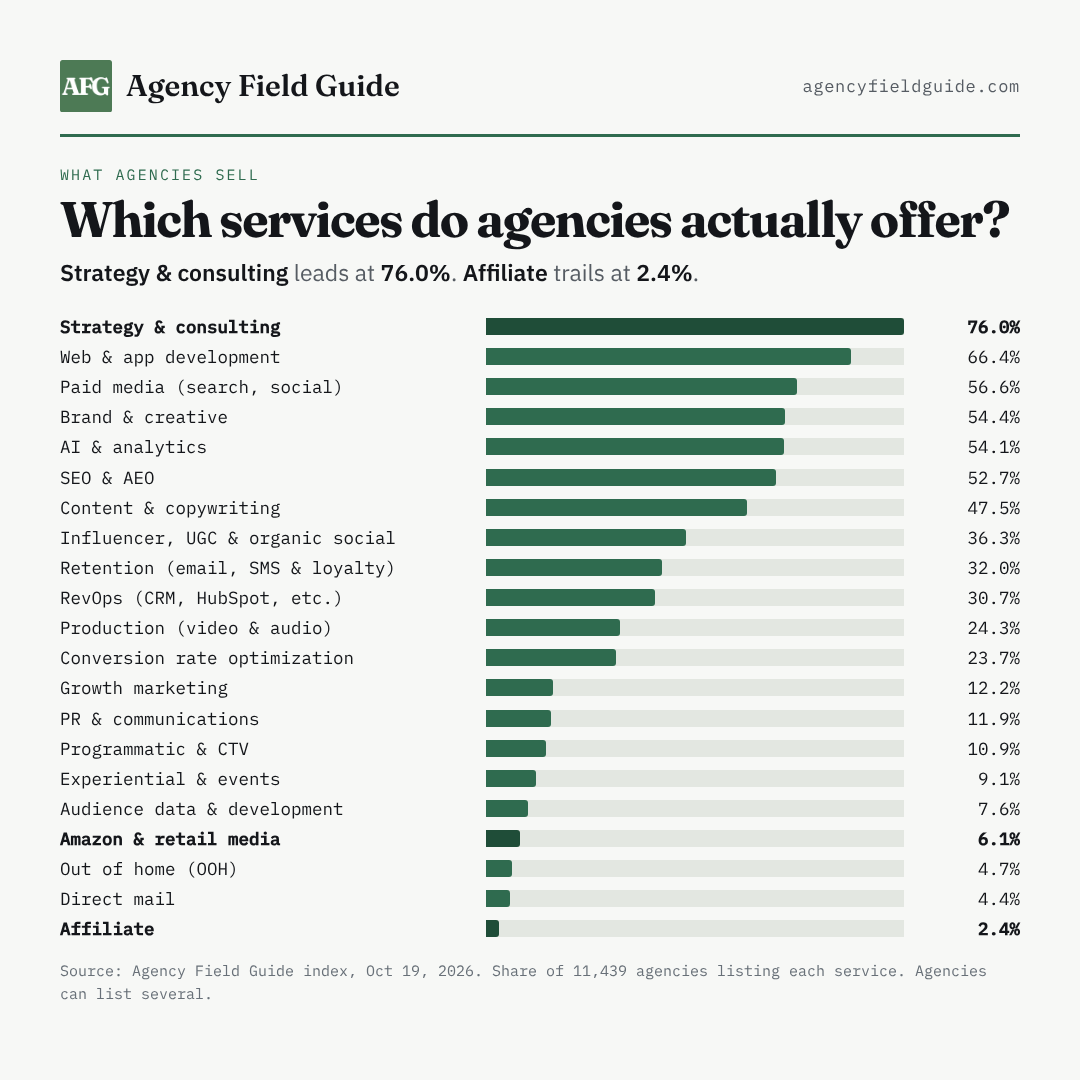
The short answer: Agency Field Guide looked at the services 11,439 agencies say they sell. Strategy is the most crowded claim in the agency world, at 76%. That doesn't mean you can't win there. Amazon (6.1%) and affiliate (2.4%) are the emptiest. That doesn't mean they're gold mines. In both cases the opportunity comes from the same place: seeing more of where a client's money actually moves than the client can see on their own.
- 76.0%of agencies claim strategy & consulting
- 6.1%offer Amazon, marketplaces or retail media
- 2.4%offer affiliate marketing
Go look at ten agency websites. It doesn't matter which ten.
Somewhere on every services page, usually first, sits “Strategy & Consulting.” It's the bread basket of the agency world. It's on every table, nobody ordered it, and nobody is getting charged for it.
Now look for an agency that sells Amazon. You'll be clicking for a while.
Roughly 40% of U.S. online retail sales run through Amazon, yet only about one agency in sixteen says it works there. Affiliate drives an estimated 9.4% of U.S. ecommerce sales, yet one agency in forty sells it. Meanwhile three agencies in four claim to sell strategy, which is a lot of strategists for a market where most clients would struggle to name the last strategy deliverable they paid for.
So which of these are opportunities, and which are warning signs?
What do 11,439 agency service menus actually say?
We classified the publicly described services of every agency in the Agency Field Guide index that lists at least one service into 21 categories. An agency can appear in as many categories as it claims.
What agencies sell
Which services do agencies actually offer?
Strategy & consulting leads at 76.0%. Affiliate trails at 2.4%.
Is strategy too crowded to compete in?
Of the 8,691 agencies that claim strategy, 76 list strategy as their only service. That's fewer than one in a hundred. More than 80% of agencies claiming strategy also list at least four other services, and the typical one lists seven.
Strategy as a product
How many services do strategy agencies list?
Of 8,691 agencies claiming strategy, only 76 sell it on its own.
- 761
- 5182
- 1,0253
- 1,0664
- 8085
- 8036
- 8587
- 8048
- 8269
- 1,90710+
Total services listed
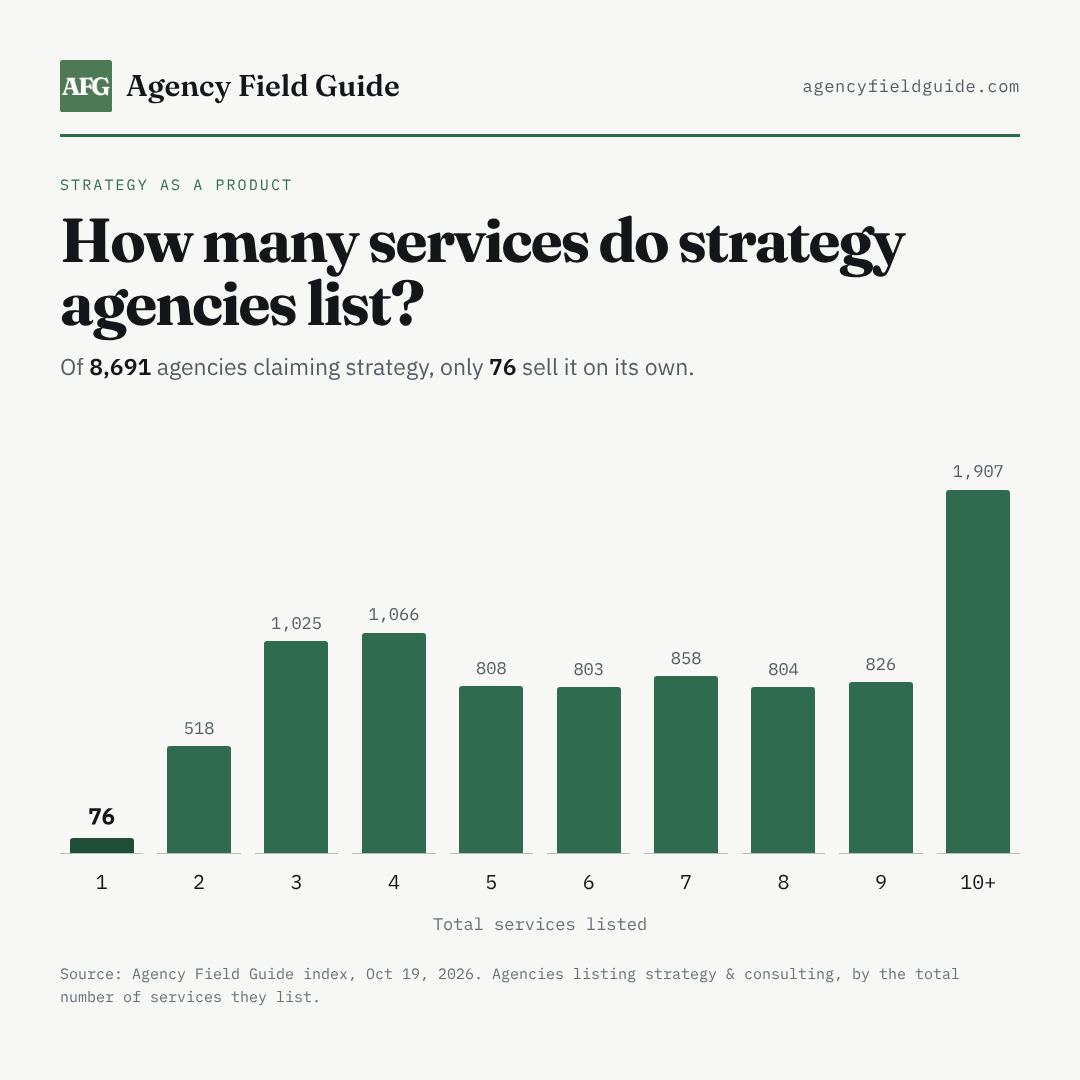
Strategy is a crowded label and a nearly empty product. Most agencies put “strategy” on the menu the way restaurants put “fresh” on the menu. Leaving it off would look weird, and nobody expects to be charged extra for it.
(If you've ever had a prospect say “the strategy is included, right?” you already knew this.)
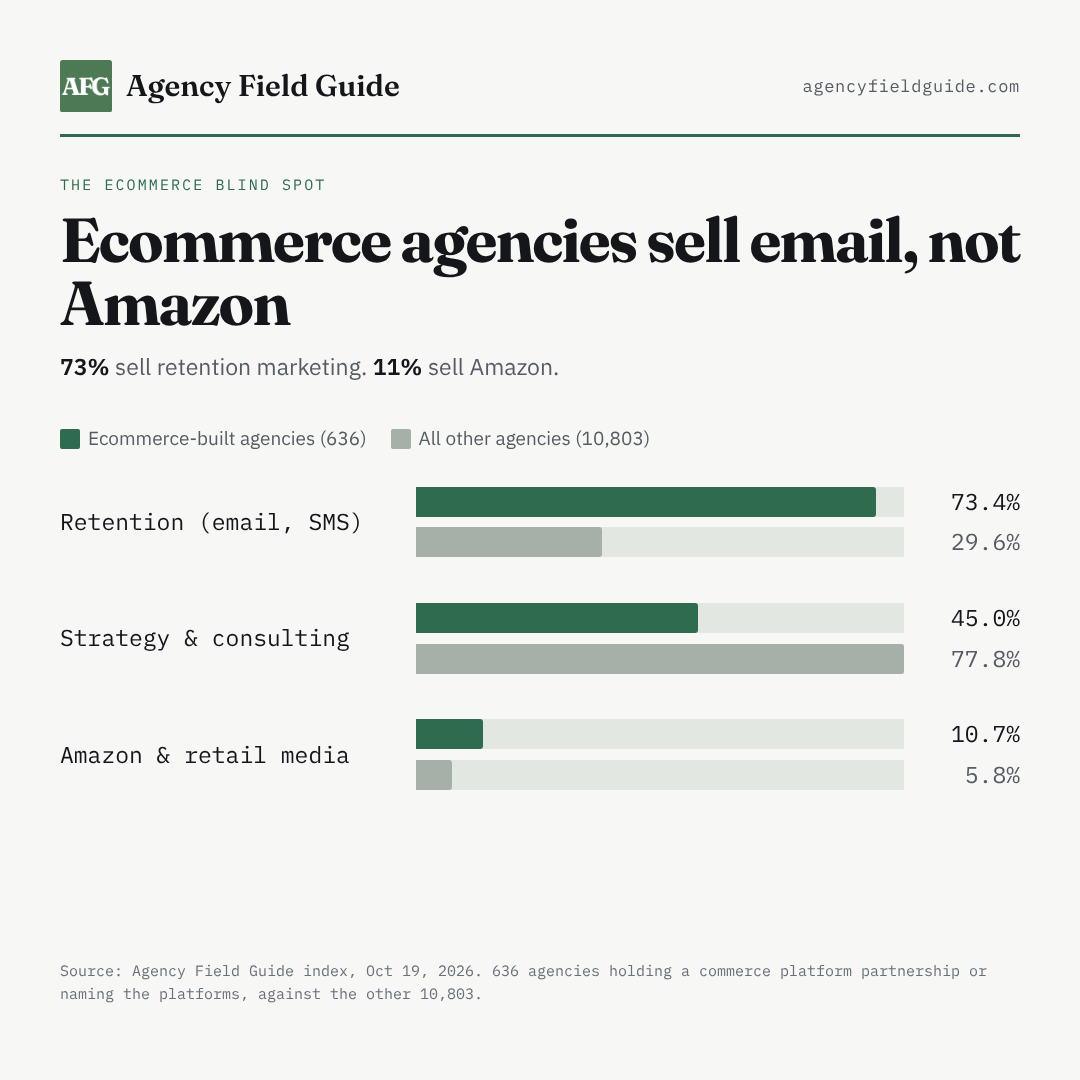
Among the 636 agencies most clearly built around ecommerce (the ones holding commerce platform partnerships or naming the platforms they work in), only 45% claim strategy, compared with 78% of everyone else. The agencies closest to the transaction are the least likely to say they own the plan. That leaves a seat open at the table, and it's the seat that decides what everyone else at the table does.
You can win that seat. You just can't win it with what most agencies are calling strategy.
Make your strategy the thing the specialist work depends on
The kickoff starts. The agency walks through twelve slides of personas, a positioning statement and a funnel diagram. The client nods politely. Everyone is quietly waiting to get to the slide with the media plan on it. Three months later, the paid team, the email team and the client's in-house people are all doing what they would have done anyway, and nobody has opened the strategy deck since the kickoff. The client paid for a preamble to the media plan.
Strategy worth paying for decides things the specialists can't decide for themselves. It sets how budget splits across channels, what each channel is accountable for, what gets sequenced first and which numbers count as success. If your paid media team, the client's Amazon partner or the email agency could execute just as well without reading your strategy, then your strategy is decoration.
Ask whether the specialist work would get worse if your strategy disappeared. If the honest answer is no, the client will eventually figure that out, usually around renewal time. (We wrote more about who should own strategy when a brand has several agencies in Who owns strategy with multiple agencies.)
Build it on something the brand can't see by itself
A brand sees its own numbers. You see the numbers of every client you've ever run. That's the only unfair advantage an agency has over a smart in-house marketing director, and most agencies leave it in the drawer.
Strategy earns a fee when it's built on things the client cannot get alone, such as:
- Patterns across many accounts, like what usually happens to site conversion when a brand's best seller goes on promotion on a marketplace.
- Benchmarks from your own book of business instead of a vendor's blog post.
- Tools or data the client doesn't own, like marketplace search share, competitor pricing history or a combined view of site and marketplace sales.
- Lessons from channels the client doesn't run yet, which is where Amazon and affiliate come back into this story.
If the client's marketing director could produce your strategy with a search engine and a free Friday afternoon, they will eventually stop paying for it.
Why are there so few Amazon agencies?
EMARKETER estimates Amazon will account for about 39.7% of U.S. retail ecommerce sales in 2026. Its H2 2025 forecast put U.S. retail media ad spending at roughly $69 billion for 2026, and Amazon takes most of it.
And yet only 699 agencies in our index, 6.1%, say they work on Amazon, marketplaces or retail media.
Some of the reasons are real warning signs, and you should take them seriously.
- The work is operational. Listings, inventory, pricing, reviews, catalog errors and the occasional suppressed product page at 11 p.m. on a Friday are not classic agency work.
- The margins are squeezed. Marketplace fees, fulfillment fees and ad costs come out of the same product margin your retainer does.
- There's a lot of competition that isn't an agency. Amazon's own tools, software platforms, aggregators and in-house teams all compete for the work.
A bolt-on Amazon practice run by people who'd rather be doing brand campaigns is a hard business.
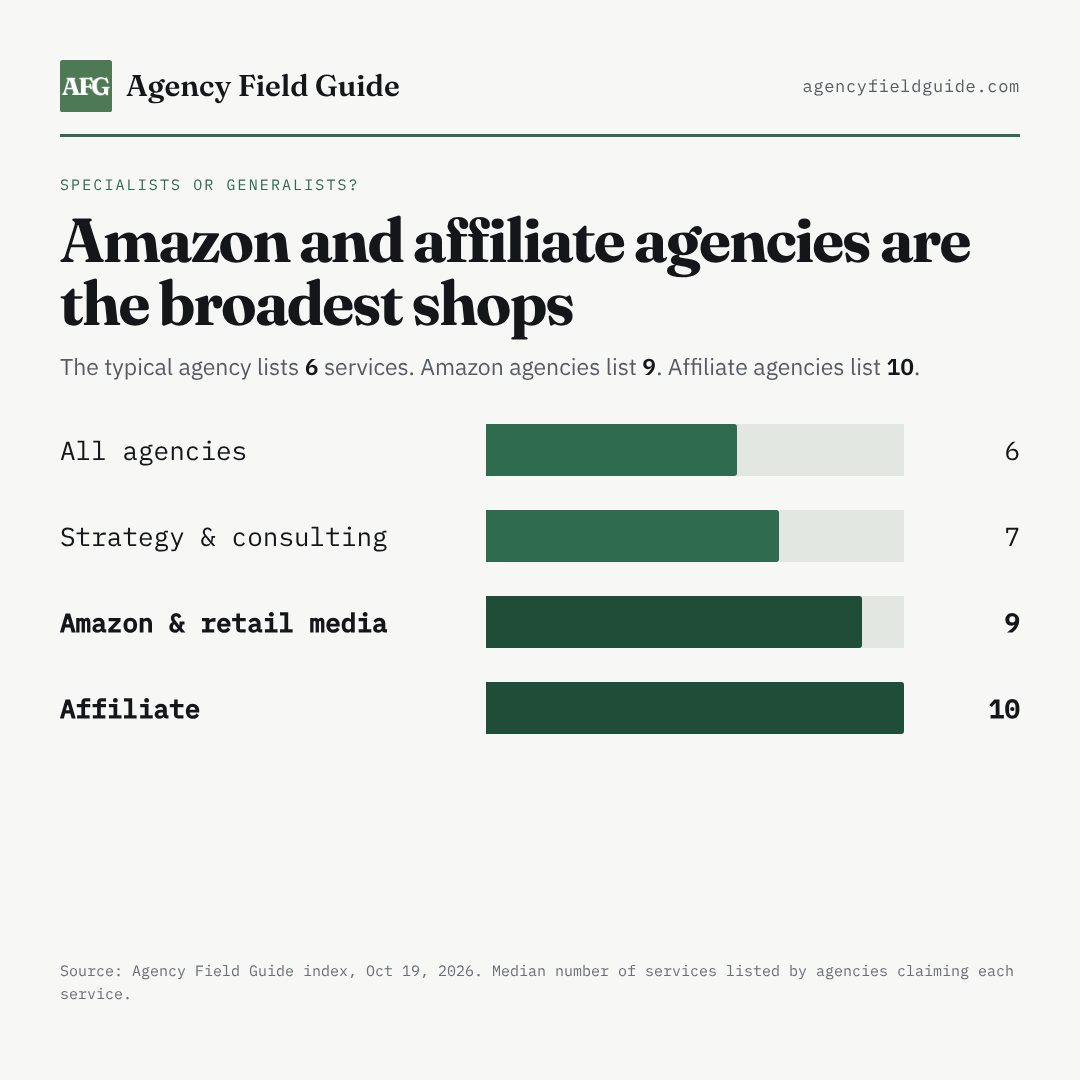
The agencies that actually do Amazon work are some of the broadest in the index. The typical agency in our data lists six services. The typical Amazon agency lists nine. Only 10 of the 699 list two services or fewer.
Specialists or generalists?
Amazon and affiliate agencies are the broadest shops
The typical agency lists 6 services. Amazon agencies list 9. Affiliate agencies list 10.
Amazon & retail media agencies
What else do Amazon agencies sell?
They are twice as likely to sell CRO and nearly six times as likely to sell affiliate.
- Amazon & retail media agencies (699)
- All agencies (11,439)
- Paid media
- AI & analytics
- Retention (email, SMS)
- Conversion rate optimization
- Affiliate
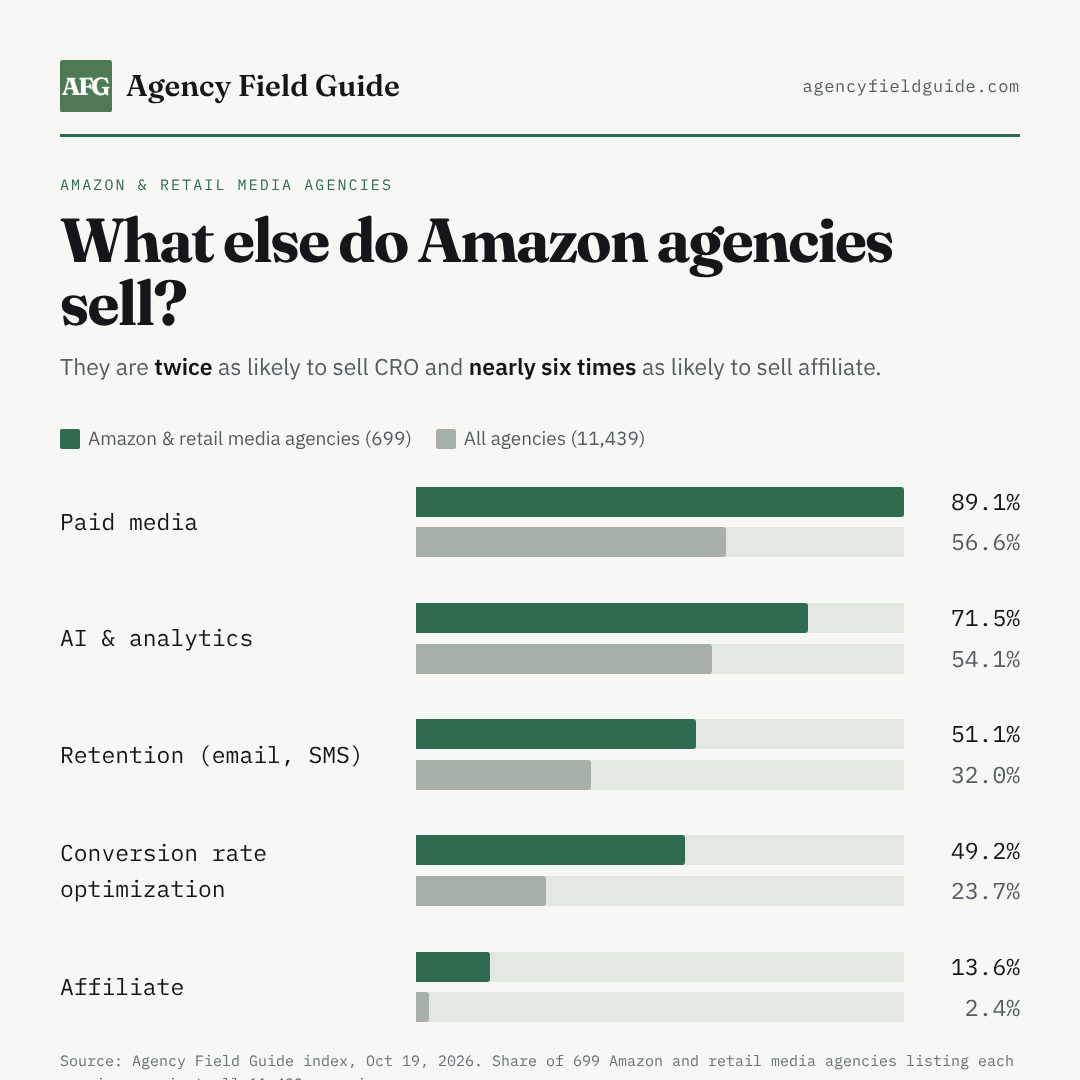
These agencies follow the money all the way to the checkout, whichever checkout the customer chose.
The ecommerce blind spot
Among the 636 agencies most clearly built around ecommerce platforms, 73% sell retention marketing and 11% sell Amazon. They're almost seven times more likely to help a brand email its customers than to help it sell on the store where about 40% of U.S. online retail shopping happens.
The ecommerce blind spot
Ecommerce agencies sell email, not Amazon
73% sell retention marketing. 11% sell Amazon.
- Ecommerce-built agencies (636)
- All other agencies (10,803)
- Retention (email, SMS)
- Strategy & consulting
- Amazon & retail media
A brand's paid social ads do their job. Someone sees the ad, thinks “oh, that looks good,” opens the Amazon app, searches for the brand and checks out with Prime because the shipping is free and their card is already saved. The brand's website analytics record nothing. The paid social report shows return on ad spend sliding. The client cuts the budget. Amazon sales soften a few weeks later. Nobody connects the two, because nobody in the room can see both.
The agency with marketplace visibility can connect them, and clients will pay for an agency that can explain why their numbers moved.
Is affiliate a dead end or an open lane?
Affiliate is the quietest category in our data. Only 269 agencies, 2.4% of the index, say they sell it.
The Performance Marketing Association's 2025 industry study puts U.S. affiliate marketing spending at $13.62 billion in 2024, up 49.8% from 2021, and estimates that affiliate drove $113 billion in ecommerce sales, about 9.4% of the U.S. total.
Few agencies sell it because affiliate networks, partnership software platforms, publishers and in-house partnership teams already do a lot of the basic program management. If your affiliate offer is “we'll recruit some partners and send the monthly report,” software is coming for that job, and it's probably already there.
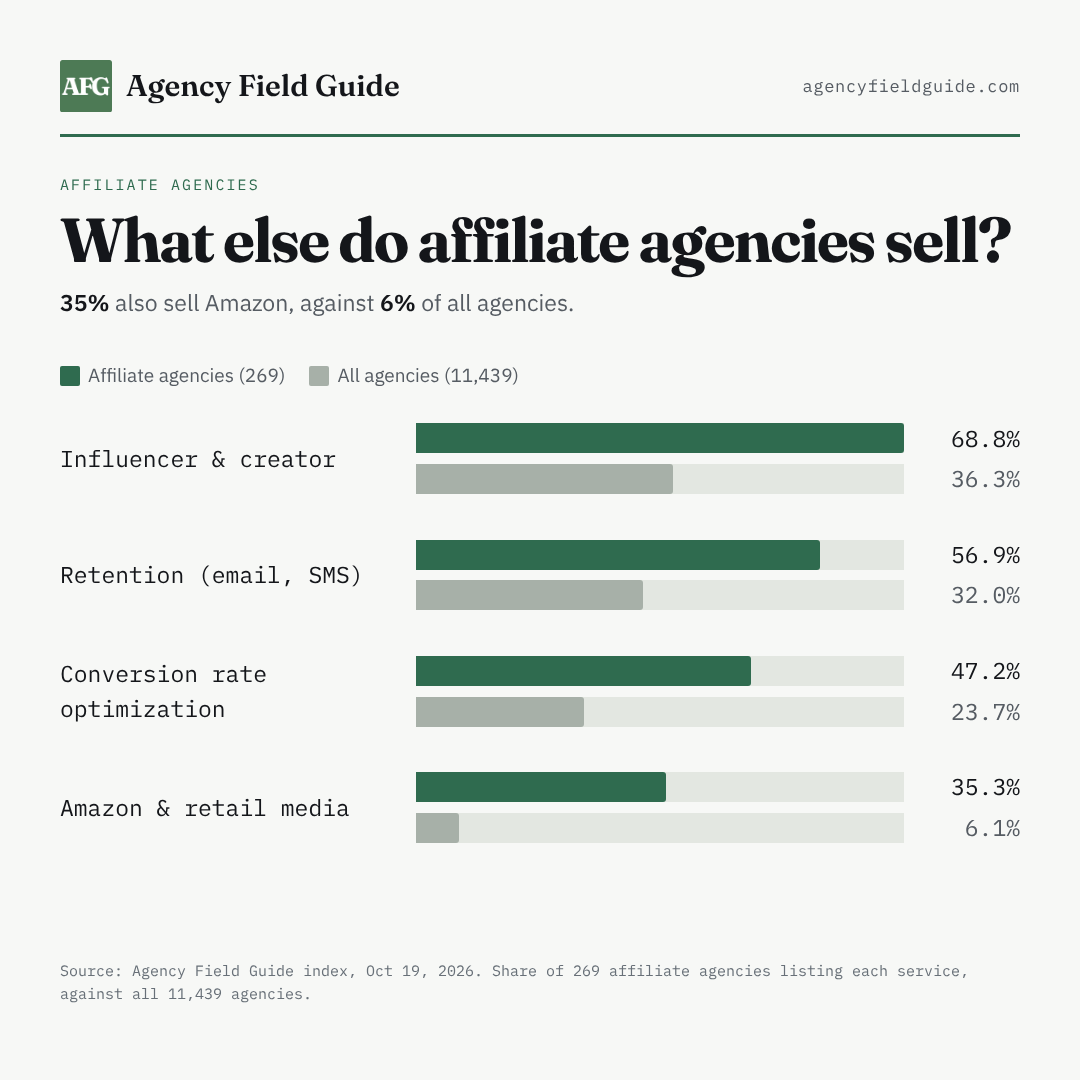
The typical affiliate agency lists ten services, the most of any category we track.
Affiliate agencies
What else do affiliate agencies sell?
35% also sell Amazon, against 6% of all agencies.
- Affiliate agencies (269)
- All agencies (11,439)
- Influencer & creator
- Retention (email, SMS)
- Conversion rate optimization
- Amazon & retail media
Affiliate is where the attribution fights happen. Coupon, cashback and loyalty sites can sit right at the last click and collect a commission on sales that were going to happen anyway. Meanwhile, a creator who actually introduced the customer to the brand three weeks earlier gets nothing. An agency that understands affiliate can tell a client which partners create demand and which ones charge a toll at the register. That insight changes the reported performance of every other channel in the plan, including yours, and the brand can't get it from its own dashboards. (Our guide to evaluating overlapping agency attribution covers how buyers try to sort this out, and it's worth knowing what they're looking for.)
So are Amazon and affiliate opportunities or warning signs?
They can be either. The difference is what you build.
As standalone niches, they come with real warnings. Operational work, thin product margins and competition from software and networks make “we'll add an Amazon service line” a riskier move than it sounds in a planning meeting.
As sources of insight, they're one of the most underused advantages available to an agency. The agencies already doing this work see the whole purchase path, which makes their strategy worth paying for.
You don't have to run the Amazon account to be the agency that understands what Amazon is doing to your client's numbers. You do have to stop treating the client's website as the whole store.
- BuildMost of your clients sell physical products, and you can staff operational work and price for it. Build an Amazon or affiliate practice and price it on the work, not as a bolt-on.
- PartnerYour clients sell on marketplaces or run affiliate programs, but you don't want the operational load. Partner with a specialist and own the integrated plan, the shared measurement and the budget conversation.
- SkipYour clients are mostly B2B or services businesses. These channels won't help them much, and pretending otherwise will hurt your credibility.
If you partner, pick carefully. You can browse Amazon and marketplace agencies and affiliate agencies in the directory, and our guide on how to find agency partners covers what to check before you put your name next to theirs.
What should you answer before adding a service?
Ask yourself these before you add anything to your services page, whether it's Amazon, affiliate or a sharper version of strategy.
- Which of our current clients would buy this in the next six months, and how much would they spend?
- What will we be able to see for clients with this service that we can't see today?
- How does that view make our existing services perform better or easier to prove?
- Who already does this work for our clients: software, a network, an in-house team or another agency?
- Can we deliver it profitably after the platform fees and operational work, or does it only work as a loss leader?
- Would our strategy change if this channel's data were in it? If not, why are we adding it?
If you can't answer the third and sixth questions, you're about to add another line to the services page and not much else.
Frequently asked questions
- What percentage of marketing agencies offer Amazon services?
- In the Agency Field Guide index, 699 of 11,439 agencies (6.1%) say they offer Amazon, marketplace or retail media services, as of October 2026.
- What percentage of marketing agencies offer affiliate marketing?
- 269 of 11,439 agencies (2.4%) say they offer affiliate marketing, making it the least common of the 21 service categories Agency Field Guide tracks.
- What is the most common service marketing agencies offer?
- Strategy and consulting. 8,691 agencies (76.0%) claim it. However, only 76 of them list it as their only service, so it is almost always sold alongside other work.
- Why are there so few Amazon agencies if Amazon is so big?
- Amazon work is operational, product margins are tight after platform fees, and software platforms, aggregators and in-house teams compete for the work. The agencies that do offer it tend to be broad, multi-service agencies rather than narrow specialists.
- Is affiliate marketing a good service for an agency to offer?
- Basic program management is increasingly handled by networks and software. The stronger opportunity is using affiliate expertise to understand attribution and partner quality across a brand's whole marketing mix, either by building the capability or partnering with a specialist.
- Can an agency compete in marketing strategy when most agencies already offer it?
- Yes, if the strategy directs the specialist work and is built on insight the brand can't get alone, such as cross-client patterns, proprietary benchmarks or visibility into channels like marketplaces and affiliate. Very few agencies sell strategy as a standalone product.
Methodology
Agency Field Guide classified the publicly described services of 11,439 agencies into 21 categories. These are the agencies in our index of 14,466 active agency listings that describe at least one service. An agency counts in every category it claims, so percentages add up to more than 100%.
These numbers measure what agencies say they sell. They don't measure verified delivery capability, revenue mix, client demand or the total population of agencies. Co-occurrence figures, like the share of Amazon agencies that also sell conversion rate optimization, compare the agencies claiming one service with the full index.
“Agencies most clearly built around ecommerce” means the 636 agencies that hold a commerce platform partnership or name specific ecommerce platforms in their service descriptions.
External market figures come from EMARKETER and the Performance Marketing Association and are included for context. They measure different things than our index and aren't directly comparable. Read more about how the index works.